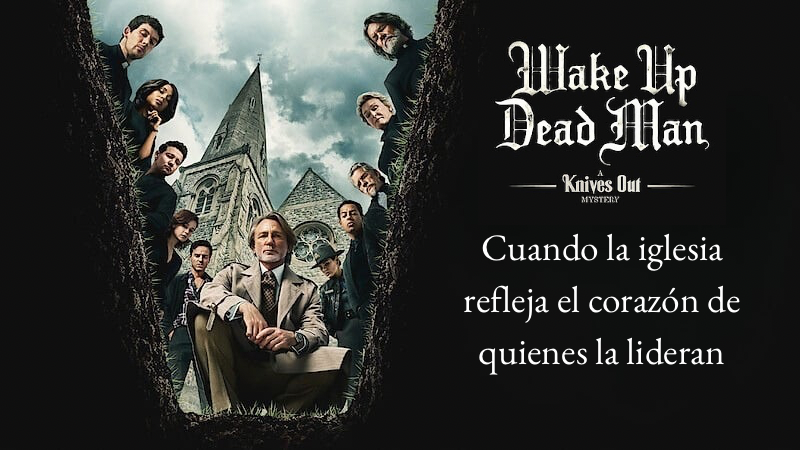
Wake Up Dead Man: A Knives Out Mystery is not simply a mystery film. It is a modern parable about spiritual leadership, abuse of power, and the absence (or recovery) of the love that defines the church. Beneath its detective narrative, the film posits a deeply biblical and Augustinian truth: The church always reflects the love that governs the hearts of those who lead it.
MOVIE SPOILERS
Grace: the "sinner" who never received grace
For much of the film, Grace is seen as a harsh, scorned woman, labeled a "whore." An uncomfortable figure, judged, marginalized. But this superficial reading is precisely the denunciation the film seeks to expose.
Grace did not choose her path. She was forced by her father to remain in the church, under the promise of an inheritance that would finally allow her to be free. When that promise is broken, all that remains is confinement, frustration, and despair.
Here resonates a forgotten evangelical truth:
“Judge not, that ye be not judged.” — Matthew 7:1
Grace does not destroy the temple out of hatred for God. She destroys it seeking a promise that was never fulfilled. Her act is not blasphemy; it is the cry of a victim trapped in a hostile institution that never offered her refuge.
When she tears down the cross from the altar, one of the most powerful symbols of the film occurs, and we do not see the complete cross for much of the story, only its shadow.
This communicates something devastatingly honest:
the form remains, the religious language remains, the institution remains... but Christ is no longer at the center. And not because of Grace's fault.
Monsignor Wicks: when love turns inward
This is where Saint Augustine's reading deeply illuminates the film.
In The City of God, Augustine describes two cities formed by two loves:
"Two loves founded two cities: the love of God carried to the contempt of self, founded the City of God; the love of self carried to the contempt of God, founded the earthly city." — The City of God, XIV, 28
Monsignor Wicks embodies the earthly city.
His leadership is not guided by the love of God, but by the disordered love of himself: for power, for control, for image, for authority. The church becomes a means, not a mission.
This kind of love produces exactly what Augustine warned against:
- domination instead of service,
- control instead of care,
- fear instead of grace.
Scripture states it clearly:
“The rulers of the Gentiles lord it over them… but it shall not be so among you.” — Matthew 20:25–26
When love is directed toward the self, leadership becomes a power drive. And the church begins to resemble an empire more than the Kingdom of God.
A church without Christ… even if it still uses his name
Under Wicks' leadership, the church functions externally but is spiritually empty. Grace is judged without being heard. The institution is protected before people. Holiness is confused with control.
Here another biblical warning is fulfilled:
“This people honoureth me with their lips; but their heart is far from me.” — Matthew 15:8
It is not that God has abandoned the church.
It is that the church ceased to reflect the heart of God.
Father Judd: the love that brings Christ back to the temple
In absolute contrast appears Father Judd.
Judd represents the other love of which Augustine speaks: the love of God, which does not annul the self, but orders it correctly. It is a love that produces justice, compassion, and humility.
Judd does not seek to win cultural battles. He does not govern out of fear. He deeply believes that:
“For the Son of Man did not come to destroy men's lives but to save them.” — Luke 9:56
His leadership is pastoral, not imperial. Christ-centered, not self-centered.
And it is only when Judd acts from this love, offering grace even in the midst of chaos, that the film suggests something beautiful: Jesus is present again in that church. (Represented at the end of the film with the new cross created by Father Judd)
Not through the restoration of the building, but through the restoration of the heart that leads.
The church as a mirror of the love that governs it
Saint Augustine helps us name what the film shows:
- When love is directed toward God: leadership serves, heals, and gives life.
- When love is directed toward the self: leadership dominates, manipulates, and destroys.
“He that loveth not knoweth not God; for God is love.” — 1 John 4:8
Grace was a victim of a church governed by the wrong kind of love. Judd becomes a sign that another path is still possible.
What love is shaping our church?
Wake Up Dead Man confronts us with a question we cannot evade. What kind of love is shaping our leadership? Because the church will always reflect that love.
If it is love for God, it will reflect justice and mercy.
If it is self-love, it will reflect power and oppression.
And as Augustine would say, our belonging to a city depends on that love.
0 comments