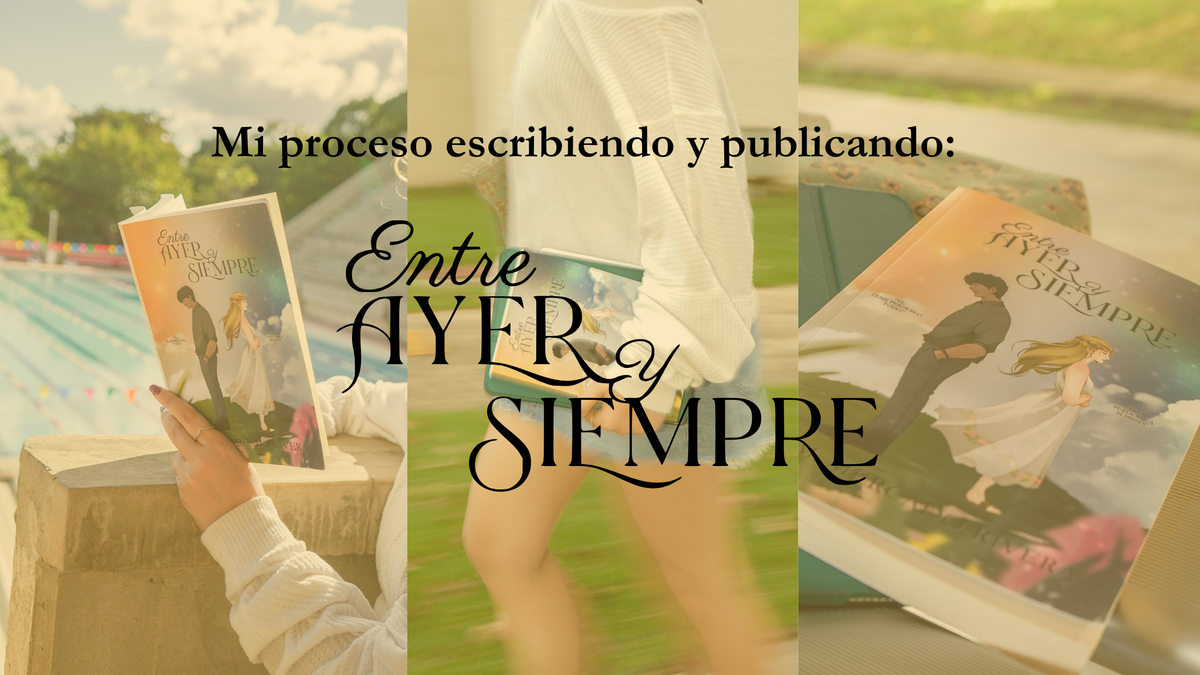
What I learned, my mistakes, and what I would do differently
Before I begin, this is not a universal formula. This is my personal experience publishing my book, with my successes and blunders. Your path may be different depending on your genre, budget, time, goals, and personality.
I will divide it into three parts:
- Writing process
- Preparing to publish
- Promotion and reception (what happens after releasing the book into the world)
Writing process: finishing is the first victory
The hardest part: writing (and finishing)
Most writers never finish their first draft. Not because they lack talent, but because they get stuck editing, doubting, or waiting for "perfect inspiration." In my case, it all started with the idea, and then I began to build a map: outline, character analysis, references, music, series, and themes that matched the vibe I wanted for the book.
A resource that helped me a lot was Abbie Emmons (content creator and writer). She has videos in English about ideas, characters, structure, dialogue, etc., and also free and paid resources. (Not a promo haha; it was just useful for me.)
Essential rule of the first draft: don't edit, just finish. My reality was that the first draft took me about 4 months. When you start chapter 1, your job is simple: keep writing until you reach the end.
- Make time, even if it's 45 minutes or 1 hour a day (or blocks per week).
- If you get stuck, mark the spot (write "REVIEW THIS SCENE" or "RESEARCH THIS") and move on to the next scene.
- Don't stop to rewrite each chapter as if it were the final version. You'll be stuck there forever.
When you finish... step away from the manuscript
Finishing the first draft is a huge accomplishment. But after that, the best thing I did was not touch the manuscript for a while. I let it rest for about 4 weeks. That helped me return with more objectivity and less emotional attachment than I had before. During that break, live your life. Study, work, play, paint, write something else, disconnect. Whatever... but give the story some distance.
Self-editing: the stage where you break... and improve
Here comes the painful part. You will sit down and see the text you wrote and believed would revolutionize literature. You will read it and say, "but what garbage." That's normal. It doesn't mean you're bad; it means you can now see clearly. My reality was that I spent about 5 months self-editing, and this is what worked for me:
- I printed the manuscript and read it with colored highlighters.
- I looked for inconsistencies, superfluous scenes, elements I introduced and then never mentioned again, important things at the end that weren't planted from the beginning.
Editing order recommendation (from large to small)
This helped me not get lost in the process:
- Full story / structure (arc, pace, conflict, ending)
- Chapter by chapter
- Scene by scene / paragraph by paragraph
- Line by line (style, repetition, language)
That "top-down" idea was key to not editing comma by comma when the plot still needed many changes.
A specific tip I would have liked to know earlier while writing is... avoid "double verbs"
Sometimes we describe indirectly: "I feel the sand scrape my back." That becomes repetitive. Better: "The roughness of the sand scrapes my back." It's more direct and more immersive. Look for words like (I feel, I see, I hear etc...) in your manuscript and describe them better.
Editors: the expensive part... but where the book levels up
Once you know your story "inside and out," an important stage comes: finding editors. This hurts (and costs $$$), because they point out what you don't see... but it helps you grow as a writer.
In my case, I worked with several editors with different roles: structure/narrative, repetition, coherence, and proofreading/spelling/formatting.
Tip: save up and look for options (networks, recommendations, platforms). Read their opinions, experience, and approach carefully before paying.
Preparing to publish: decisions that determine your control and costs
First: decide the route (traditional vs. independent)
There is no "best option" here, only the "best option for you."
- Traditional: a publisher invests in various things (ISBN, cover, distribution, etc.), but you lose control and depend on the contract. Ideally, do not sign without guidance from someone knowledgeable (agent or legal/editorial advisor).
- Independent (self-publishing): you control everything and the profit is more yours, but everything depends on you (time, money, decisions, mistakes).
I went the independent route. And the following reflects the decisions I made for this path.
The administrative/legal: copyright and ISBN (in simple language)
Important reminder: your story is yours from the moment you write it, but registering/organizing the legal aspects can help you if any problems arise.
About the ISBN:
- Amazon can offer "free" ISBNs, but they are often tied to Amazon (depending on the country and conditions).
- If you want more control to move your book to different places, you can buy your own ISBNs. I used Bowker and bought a package (in my case, 10) thinking about future formats.
-
Each format needs its own ISBN: eBook, paperback, hardcover, audiobook, other language, etc.
For copyright, I used this video to help me register my manuscript
The 3 things that sell most (before anyone reads a single page)
For me, publishing comes down to three pillars:
- The manuscript (real quality)
- The description (what convinces)
- The cover (the first impression)
If you fail in one, the book suffers. The cover matters because yes, we judge books by their cover... myself included.
My experience: I worked on my cover with a Puerto Rican artist, Sugar Dells, and we aimed for it to represent the book well and be visually striking. Always ask for the specifications of size (trim size), spine, bleed, etc., depending on the platform.
Platforms: where to publish (and where to print)
The most popular platform is Amazon KDP. You can publish paperback and Kindle, and if you join Kindle Unlimited, it implies eBook exclusivity with Amazon.
What I did:
- I used KDP for Amazon/Kindle without exclusivity, because I wanted to be in other places.
- For eBook distribution in multiple stores, I used Draft2Digital because it allows you to place the eBook in various retailers from a single location. Here's a link for working with Draft2Digital
- For physical copies, I compared options. In my experience, ordering author copies with KDP can take longer; with Draft2Digital, it worked better for me in terms of quality/time, although it sometimes costs more, and I also tried external printers like OnPress Printing to speed up delivery times.
Recommendation (Don't make the same mistake I did): this needs to be done with time. Time is the independent author's number one enemy.
Bookstores: wholesale vs. consignment (what no one calmly explains to you)
Each bookstore works differently, but in general, I saw two models:
- Wholesale / purchase with discount: the bookstore buys from you at a % discount (for example, 40%). If your book costs $20, you sell it to them for $12, and they sell it for $20.
- Consignment: you leave books, they sell, and the % is divided (e.g., 70/30). Unsold books can be returned.
Management tip (seriously): document everything. Invoice, quantity delivered, date, condition, terms.
Direct sales: where you make the most profit (but also the most work)
Selling yourself usually yields more profit, but it requires logistics: packaging, shipping, inventory management, payment methods.
I set up a store on Shopify to centralize sales and have "a single link" to share. It helped me simplify life for the reader: I send them the link, and that's it.
Promotion and reception: what happens when the book is already out
Dual mindset: you're selling a product... and an experience
Promoting is uncomfortable, especially when the book is your baby. But here was a mindset shift:
- Yes, you're selling a product (with costs, margins, distribution).
- But you're also selling a story and an emotional experience. And that part is what connects.
I started promoting early
I started talking about the book as soon as I finished the first draft: I shared the process, what I liked, what I struggled with, the "behind the scenes." In essence, I invited people to be part of the adventure.
And it helped me a lot to be clear about:
- What about your book is engaging?
- What emotions do you want the reader to feel?
- What makes it different?
Each social media platform requires a different promo
In my experience:
- Instagram: worked for visual content (tropes, aesthetics, quotes, edited clips).
-
TikTok: more spontaneous and personal; speaking to the camera, being vulnerable, and sharing the process works well.
ARC Readers: reviews before launch (and why they matter)
ARC readers helped me have reviews ready to motivate other readers. I created a form, chose a variety of people and platforms (Amazon, Goodreads, Fable, and people who make videos).
I also sent physical copies to some content creators I had followed before (not out of "interest," but as a thank you and because I genuinely liked their content). I prepared a package with a bookmark/card so that if they wanted to do an unboxing, they would have material.
Important rule... don't be fake: don't manipulate. Don't ask for fake reviews. Be humble and let the book speak for itself.
Presentations and events: where the book becomes real
Presenting the book at bookstores, festivals, and events was key. Talk to the venues, understand their rules, and strategically choose where to be.
The reception (the good, the strange, and the difficult)
The part I want to tell you
- Receiving support feels amazing... but it can also give you anxiety.
- Receiving criticism can hurt, even if it's fair.
- And the most unexpected thing: after the launch "rush," there comes a moment of silence where you think: "now what?"
The important thing here is to understand this: the book doesn't sell itself. Promotion doesn't end the day it's released. It continues, but in a sustainable way.
My mistakes (so you don't make the same ones)
I'm not going to pretend: I made mistakes... many of them, and among them were:
- Buying things I later didn't use
- Choosing platforms that weren't convenient for me (or that I didn't fully understand at first)
- Trying to rush the process and finish against the clock
If I could tell my past self something, it would be:
research, take your time, plan with margin, and don't despair. Your story matters.
If you are writing your first book, I want you to take this away:
- Finishing your first draft already puts you ahead of most.
- Editing will hurt, but it will shape you.
- Publishing independently gives you freedom, but demands structure.
- Promoting feels weird... until you understand that you're not "begging," you're inviting people to an experience.
And if any of this helps you, even a little bit, it was worth it.
0 comments